Private Cloud Server: Definition, How It Works, and How to Choose One

A private cloud server is an infrastructure dedicated to a single organisation, where compute, storage and network resources are never shared with other customers. There are three clear cases where it should be your default choice: your data falls under a regulated sector (healthcare, finance, public sector), you need to guarantee a specific data location and jurisdiction, or your workload justifies predictable performance rather than pooled capacity. On the compliance side, two benchmarks stand out immediately: ANSSI's SecNumCloud qualification and the ISO 27001 standard.
- Healthcare data or public sector: look for an offering qualified under SecNumCloud or HDS.
- Unpredictable growth with usage spikes: a hybrid cloud is the better fit.
- Need for full control without in-house expertise: go with a managed offering.
Key figure: the current version of the technical framework, SecNumCloud v3.2, is today the security standard for so-called "trusted" clouds in France.
Table of contents
- What is a private cloud server, and what variants exist?
- Private, public or hybrid cloud: which model should you choose?
- What are the technical components of a private cloud server?
- What are the benefits and limitations of a private cloud server?
- How do you choose a private cloud server for your business?
- Which technical platforms shape the private cloud market?
- Yundera: a managed private server hosted in France
- A managed private cloud server, without the burden of an in-house deployment
- Sources
What is a private cloud server, and what variants exist?
The term "private server" is often used loosely to mean any dedicated machine. A VPS (virtual private server) still runs on shared infrastructure — it is simply partitioned at the logical level. A private cloud goes further: it provides an environment entirely dedicated to a single organisation, with isolated resources and centralised control, whether installed on site or entrusted to a third party.
Four variants make up the market:
- On-premises: the hardware stays on your premises, entirely under your responsibility. Maximum control, but heavy operating overhead and hardware investment.
- Hosted: the infrastructure sits with a provider but remains dedicated to your organisation. A good cost/control trade-off.
- Managed: the provider handles day-to-day operations (updates, backups, monitoring). Ideal when you have no dedicated technical team.
- VPC (virtual private cloud): an isolated space within a larger public infrastructure, combining isolation with public cloud flexibility.
An SME with no in-house IT department will naturally lean towards a managed offering. A large public body with strong sovereignty requirements will prefer on-premises or a qualified hosted offering.
Private, public or hybrid cloud: which model should you choose?
The decision comes down to four axes: control, cost, scalability and data governance. A private cloud maximises control and budget predictability, but costs more to get started. A public cloud minimises upfront investment and adjusts instantly to load, at the price of pooled resources. The hybrid cloud tries to combine both: sensitive data stays on the private infrastructure, while variable workloads shift to the public side.
- Control: high in private, limited in public, segmented in hybrid.
- Cost: heavier upfront investment in private, pay-as-you-go billing in public.
- Scalability: fast in public, slower but plannable in private.
- Governance: simpler in private (a single legal perimeter), more complex in hybrid.
An industrial company with stable production data will often go private. A software vendor with irregular traffic will lean hybrid. One thing to watch: businesses must verify exactly where their data is located and whether it meets regulatory requirements before making any decision, because the wrong jurisdiction often cancels out the technical benefits of the model you picked.
What are the technical components of a private cloud server?
Behind the marketing promise, a private cloud server rests on a specific technical stack that any IT director should be able to assess point by point.
- Virtualisation and containerisation: hypervisors (KVM, ESXi) or containers (Docker, Kubernetes) that isolate workloads.
- Storage and performance: dedicated SSD/NVMe drives, with guaranteed stable IOPS and no contention from other customers.
- Networking and segmentation: VLANs, application firewalls and micro-segmentation to partition internal traffic.
- Orchestration and automation: automated deployment tooling that reduces human error and speeds up updates.
- Backup, recovery and encryption: regular backup plans, encryption at rest and in transit, and disaster recovery procedures.
- Monitoring and access management: real-time monitoring, logging and fine-grained identity management (IAM).
Pro tip: Before signing a contract, always ask for the exact backup frequency and the real, tested restore time — not just the advertised one. Encryption that has never been tested under real conditions has no operational value.
What are the benefits and limitations of a private cloud server?
The most tangible benefit remains security through isolation: your resources are never pooled, which mechanically reduces your exposure to incidents originating with other customers. You also gain in customisation and predictable performance, since the allocated capacity is permanently reserved for you.
But those benefits come at a price. Here are the trade-offs to plan for:
- Higher entry cost than a shared public cloud, especially at low volumes.
- Heavy reliance on in-house skills or, failing that, on the quality of the provider you choose.
- Risk of technical lock-in if data export and application portability were not planned for from the design stage.
- Ongoing maintenance load for security patches, unless you go managed.
Commercial offerings in this segment range from a simple VPS to hosted private clouds with full outsourced management, which leaves real room for negotiation depending on how technically self-sufficient you are.
How do you choose a private cloud server for your business?

A rigorous checklist prevents the kind of contractual surprises that usually surface far too late — in the middle of an incident.
Technical criteria to check:
- Does the SLA guarantee a specific, contractual uptime figure, rather than just an indicative target?
- Are the RTO (recovery time) and RPO (maximum tolerable data loss) compatible with your business?
- Are backups tested regularly, with proof of restoration?
- Does encryption cover data at rest AND in transit, with clearly documented key management?
Legal and compliance criteria:
- Has SecNumCloud qualification actually been granted, or is it merely claimed to be in progress?
- Is the provider ISO 27001 certified, or even HDS certified for healthcare data?
- Is the data jurisdiction explicitly French or European, with no extraterritorial access clause?
- Our guide to GDPR compliance in the cloud sets out the contractual clauses you should insist on here.
Commercial criteria:
- Is technical support available during the hours that matter to your business?
- Is full data export guaranteed, with no hidden fees or artificial retention delays?
» A vague answer is an immediate red flag.*
To dig deeper into the legal side of this decision, our practical guide to data sovereignty details the points to watch sector by sector.
Which technical platforms shape the private cloud market?
Choosing a technical platform depends above all on the size of the organisation and the operational skills available in-house. The most frequently cited platforms in 2025 include OpenStack, Azure Stack Hub, VMware, Nutanix and Red Hat with OpenShift.
- OpenStack: a highly flexible open source approach, popular with large organisations that have solid DevOps teams.
- VMware: a mature, extensively documented ecosystem, often chosen for its stability in traditional enterprise environments.
- Nutanix: a hyperconverged architecture that simplifies day-to-day operations, well suited to small IT teams.
- Red Hat / OpenShift: container- and Kubernetes-oriented, a good fit for organisations modernising their applications.
An SME without a dedicated DevOps team is better off avoiding self-managed OpenStack and going for a hyperconverged layer or a fully managed offering.
Yundera: a managed private server hosted in France
Yundera takes a different approach: a customised private cloud server, fully managed, hosted in France, with no technical skills required on the user's side. It answers the criteria set out above directly, without you having to orchestrate the technical layers yourself.
- Infrastructure hosted in France, with a data sovereignty commitment.
- More than 100 pre-installed open source applications: file storage, web hosting, photo gallery, collaboration tools, VPN, password management.
- No data collection or resale, with export guaranteed at any time.
- Secure access to your applications from anywhere, through a custom domain.
This positioning is a particularly good fit for freelancers, SMEs and families who want to stay in control of their data without hiring a technical team. Our article on what a managed private server really changes for data ownership explains this export and reversibility mechanism in detail.
| Point | Details |
|---|---|
| Sovereignty | Infrastructure hosted in France, with no resale of your data. |
| Simplicity | More than 100 pre-installed applications, no technical skills required. |
| Reversibility | Data export guaranteed at any time, with no forced dependency. |
When should you recommend a managed solution over an in-house deployment?
Outsourcing makes sense as soon as your in-house skills cover neither security nor continuous availability. Always check the reversibility guarantees before signing: they are often the only real safety net.
— Yundera
Choosing a private cloud server comes down first to legal compliance and data reversibility, before any technical performance criteria — as explained in this analysis of the best alternatives to Actusite.fr for regulated sectors.
| Point | Details |
|---|---|
| A clear definition | A private cloud dedicates its resources to a single organisation, unlike a shared VPS. |
| Compliance first | Check SecNumCloud, ISO 27001 and HDS before making any technical decision. |
| Variant by profile | SMEs with no IT team are better served by a managed offering than by on-premises. |
| Contractual reversibility | Insist on full data export with no hidden fees or delays. |
| A managed French option | Yundera hosts in France, collects no data, and guarantees export. |
A managed private cloud server, without the burden of an in-house deployment
Unlike an on-premises deployment that demands a dedicated technical team, or a hyperscaler offering that pools your data with thousands of other customers, Yundera gives you a fully managed private cloud server, hosted in France, and never collects or resells your data.
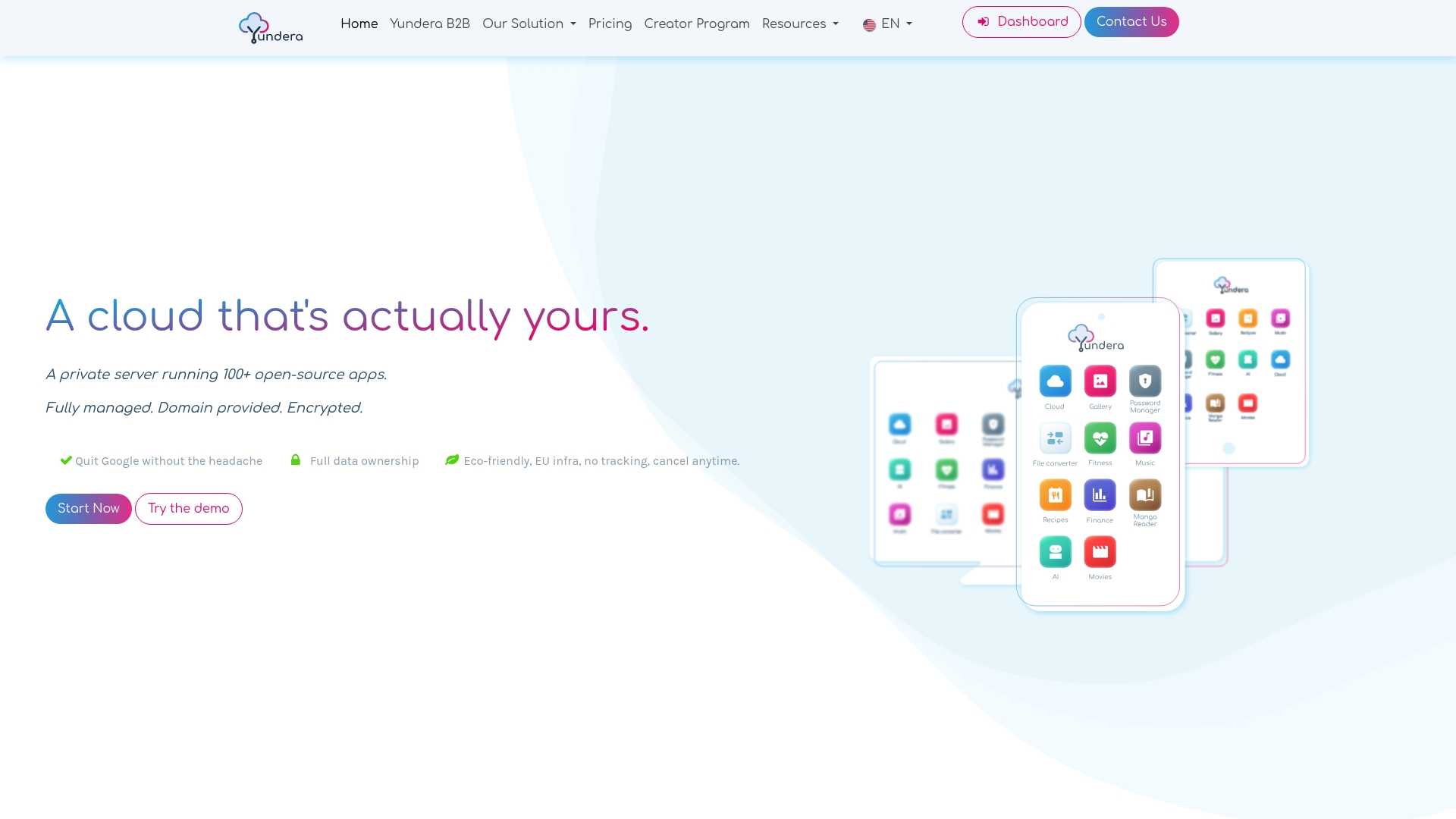
It is aimed at freelancers, SMEs and families who want to take back control of their files, websites or photos without hiring a system administrator. More than 100 open source applications come pre-installed and are accessible from anywhere through your own domain, with guaranteed export if you ever decide to leave. If that sounds like your situation, the page dedicated to SMEs and startups breaks down the savings you can make on your IT budget, and you can explore the Yundera private server offering right now to see whether it fits your needs.
Sources
- Cyber
- Private cloud: the 12 technical platforms of 2025 — LeMagIT
- What is private cloud? — OVHcloud France
- What is private cloud — AWS
Private Cloud Server: Definition, How It Works, and How to Choose One