
An IT charter (also called an IT acceptable use policy) sets the rules for using a company's digital tools: computers, email, passwords, cloud services and personal devices. Under French employment law, employees are only bound by it if it follows the same procedure as the company's internal work rules (règlement intérieur): consultation of the CSE, publication to staff, and submission to the labour inspectorate. This guide covers what a useful charter contains and how an SME can roll one out step by step.
Key takeaways:
- The French Labour Code does not require an IT charter as such, but a charter that creates general and permanent obligations is treated as an addition to the internal work rules (Article L1321-5).
- To be enforceable, the charter must be submitted to the CSE (Social and Economic Committee) for its opinion, brought to employees' attention, and sent to the labour inspector together with that opinion.
- Since Law No. 2026-403 of 26 May 2026, the work rules no longer have to be filed with the clerk of the employment tribunal (conseil de prud'hommes), but CSE consultation and publication still apply.
- No information about an individual employee may be collected through a system they were not told about beforehand (Article L1222-4 of the Labour Code), so the charter must describe the monitoring in place.
- An effective charter stays short, focuses on real-world practices (passwords, two-factor authentication, separating work and personal use, incident reporting) and is reviewed every time a tool changes.
Table of Contents
- What is an IT charter and what is it for?
- Is an IT charter mandatory?
- What should an IT charter contain?
- How do you make the charter binding on employees?
- What about companies with fewer than 50 employees?
- Can you monitor internet and email use?
- How do you govern cloud services, personal tools and AI?
- How do you keep the charter alive after publication?
- Yundera: tools you control, ready to list in your charter
- IT charter: the most common mistakes
- Sources
- Frequently Asked Questions
What is an IT charter and what is it for?
An IT charter is the internal document that sets the rules for using the company's digital resources: computers and phones, network and Wi-Fi, email, internet access, cloud services and the data that flows through them. It tells users what is allowed, what is forbidden, and what the company monitors.
It serves two purposes. The first is security: most incidents start with an ordinary action, such as a reused password, a customer file sent from a personal mailbox, or an attachment opened too quickly. The charter turns good practices like those published by Cybermalveillance.gouv.fr, the French government's cyber-assistance service, into specific instructions, including keeping personal and work use separate. The second is disciplinary: a written rule that has been properly communicated can provide grounds for a sanction.
Don't confuse it with related documents:
- Internal work rules (règlement intérieur): limited to health and safety, discipline and the scale of sanctions, rights of defence, harassment and whistleblower protection (Service-Public). The charter often becomes an annex to them.
- Information security policy (PSSI): the technical document for the IT team (architecture, backups, access rights management). It is not aimed at users.
- Privacy policy: informs customers and prospects about how their data is processed. It does not cover employees.
Finally, a twenty-page charter in legalese will be signed without being read. Aim for four to six pages, written as direct instructions, with examples drawn from the tools you actually use.
Is an IT charter mandatory?
No: under French law, no text requires a company to adopt an IT charter as such. However, as soon as it imposes rules on all employees, the law treats it like the internal work rules, and that is where the real stakes lie.
Internal work rules are mandatory in companies with 50 or more employees, once that threshold has been reached for 12 consecutive months. Below that, they are not required but remain an option (Service-Public). The charter falls under Article L1321-5 of the Labour Code: internal memos and “any other document containing general and permanent obligations” are considered additions to the work rules where these exist, and are “in any event” subject to the same regime (Légifrance).
In practice, there are two scenarios:
- Charter circulated without following the procedure: it is merely a recommendation. If an employee stores the customer database in their personal mailbox, you cannot rely on it to discipline them.
- Charter adopted under the work-rules procedure: its prohibitions become enforceable and can support disciplinary action, within the limits of the defined scale of sanctions.
The classic trap is the downloaded charter, emailed out with a request for signature, then invoked two years later in a dismissal. The signature proves the employee received it, but it does not replace the procedure.
What should an IT charter contain?
A useful charter covers about a dozen points, each phrased as a verifiable instruction rather than a general principle:
- Scope: employees, interns, temporary workers and contractors with access.
- Access and credentials: named accounts, no shared accounts, lock your session when you leave your desk.
- Passwords and 2FA: follow the guidance from Cybermalveillance.gouv.fr: long, unique passwords for each service, a password manager, and two-factor authentication wherever it is available (see our guides on password policy and 2FA).
- Email and internet: whether personal use is tolerated and its limits; verify any unexpected message through another channel, especially if it requests a payment.
- BYOD and remote work: whether personal devices are allowed, public Wi-Fi, separating work and personal use.
- Cloud and AI tools: list of approved services and an explicit ban on putting company data in a personal account or an unapproved AI assistant.
- Personal data: need-to-know access only, no exporting customer files.
- Reporting: who to alert, and how quickly, if a device is lost or a suspicious link is clicked.
- Leaving the company: return of equipment, accounts closed on the last day.
- Monitoring and sanctions: logs and filtering in place, reference to the scale of sanctions in the work rules.
Pro tip: for each clause, note in a working document which tool enforces it (group policy, MDM console, DNS filtering). Any rule that no tool or check can enforce should be rephrased or removed.
How do you make the charter binding on employees?
To be enforceable, the charter must follow the procedure in Article L1321-4 of the French Labour Code, the same one that applies to the internal work rules. Simply emailing it out is not enough. In practice, there are four steps:
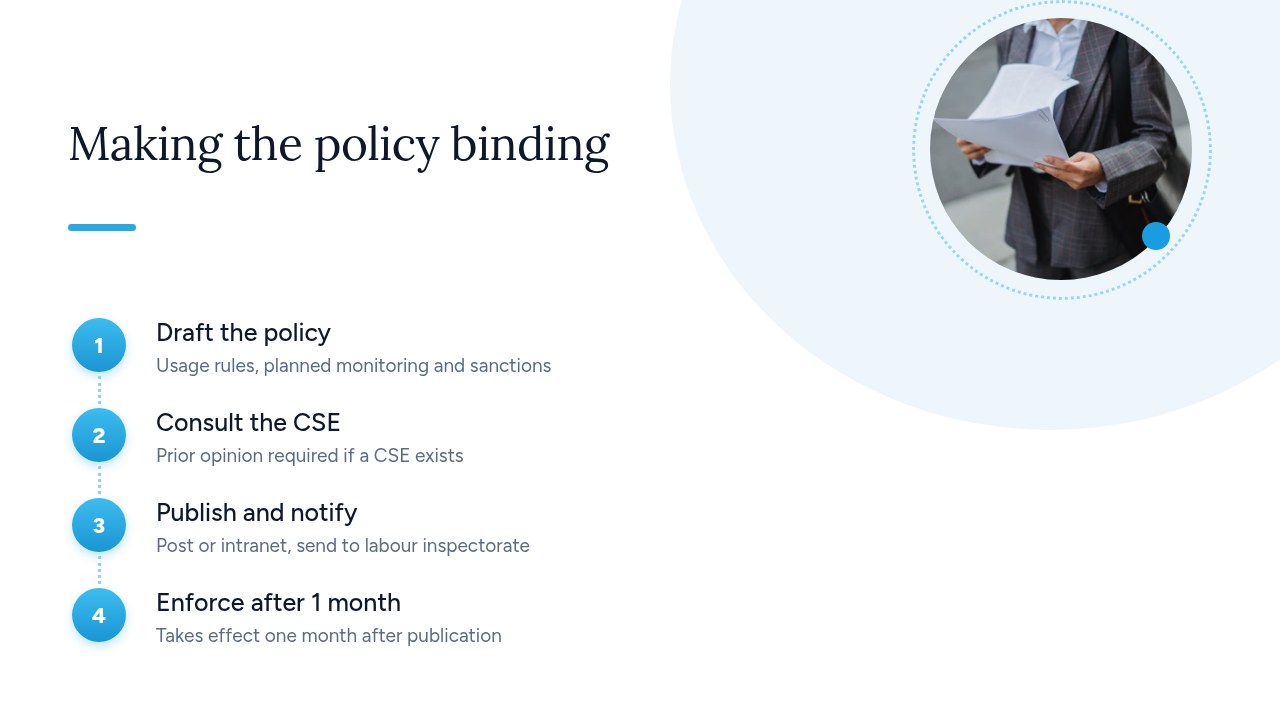
- Draft: usage rules, planned monitoring and a reference to the scale of sanctions.
- Consult the CSE: the charter “may only be introduced after being submitted for the opinion of the Social and Economic Committee” (Article L1321-4). An unfavourable opinion does not block adoption, but failing to consult makes the charter unenforceable (Service-Public).
- Publish and submit: bring it to staff's attention by any means (notice board, intranet) and, at the same time, send it to the labour inspectorate in 2 copies together with the CSE's opinion.
- Apply after one month: the effective date must be at least one month after the publication formalities.
Since Law No. 2026-403 of 26 May 2026, filing with the clerk of the employment tribunal is no longer required. When it was published, the article noted that an implementing decree was still needed to formalise this change: check that it has been issued before dropping this step from your procedures. Any amendment or removal of a clause goes through the same steps again.
Still, have employees sign a dated acknowledgement of receipt: it is your proof of distribution. For contractors and temporary workers, who are not subject to the work rules, a signature is the only way to bind them. Also attach the charter to the service contract.
What about companies with fewer than 50 employees?
Below 50 employees, the charter is still useful and can become enforceable, but the formalities do not go away. Internal work rules are not mandatory at this size, but they remain an option (Service-Public). You have two options:
- Adopt voluntary work rules and annex the charter to them. This is the clearest solution if you ever plan to sanction a breach.
- Circulate the charter as an internal memo. Be careful: Article L1321-5 states that such documents are “in any event” subject to the work-rules regime (Légifrance). You must therefore consult the CSE if there is one, publish the charter and send the text to the labour inspectorate.
In a micro-business of eight people with an external accountant and two freelancers, the risk often comes from outside: a contractor who keeps admin access after their assignment, or who stores your exports on their own cloud account. For these organisations:
- Keep it short: two to three pages focused on access, passwords, approved tools and end of assignment.
- Get it signed by every employee and every contractor, with the date and document version.
- Attach it to service contracts, with a clause on returning and deleting data at the end of the assignment.
Pro tip: keep a simple table: “person, access, date opened, planned closing date”. At the end of an assignment, it lets you close accounts in minutes and proves the offboarding clause was applied.
Can you monitor internet and email use?
Yes, an employer can monitor internet and email use, provided employees have been informed in advance and the monitoring remains proportionate. Article L1222-4 of the French Labour Code is unambiguous: “No information concerning an employee personally may be collected by a system that has not been brought to their attention beforehand” (Légifrance). A proxy log switched on without prior notice therefore cannot be used as evidence.
The charter must describe every system actually in place:
- What: firewall or proxy logs, category-based DNS filtering, anti-spam, mobile device management (MDM), application login logs.
- Why: system security, data leak prevention, incident detection. A vague purpose such as “monitoring activity” is not enough.
- How long: the retention period for each log, consistent with your GDPR record of processing activities and your retention policy.
- Who: the people who have access to the data, and under what circumstances.
The CSE must be informed of these systems before they go live. Proportionality rules out constant monitoring of a workstation, keystroke logging or continuous screenshots. Messages clearly marked as personal, for example with a subject line starting with “Personal”, cannot be opened like other messages.
Before publishing, check your clauses against the CNIL's (the French data protection authority) guidance on workplace monitoring: it is the reference its inspectors use.
How do you govern cloud services, personal tools and AI?
You govern cloud and AI use by publishing a list of approved tools provided by the company and setting one simple rule: no company data in personal accounts. This is where most charters fail. The quote saved to a salesperson's personal Google Drive, the folder sent via WeTransfer from a Gmail address, or the contract pasted into an online AI assistant for a summary never show up in the IT department's inventory.
Cybermalveillance.gouv.fr explains why: “It is important to separate your uses so that a hacked personal account cannot harm your company” (10 essential measures). In the charter, this translates into three clauses:
- Allowlist: for each need (storage, large file sharing, video calls, note-taking, AI), a designated tool with a link to access it.
- Explicit bans: personal storage and file-transfer accounts, unapproved browser extensions, unapproved online AI assistants for any customer or internal data.
- Request process: a simple procedure, such as an email to the IT contact, to get a new tool approved instead of installing it on the sly.
A ban without a practical alternative will be bypassed at the first tight deadline. If the charter bans WeTransfer, it must explain how to send 2 GB to a customer (see our guide on WeTransfer alternatives). Provide storage, sharing and collaboration tools that the company controls, then check with your teams every six months what they actually use.
How do you keep the charter alive after publication?
A charter stays effective if it is presented to every new hire, recalled every year and updated as soon as tools or risks change. Otherwise, within two years it describes software nobody uses any more.
- Onboarding: take fifteen minutes on day one to present the five key rules, get the acknowledgement signed and set up two-factor authentication with the new hire.
- Annual reminder: a short email or meeting built around a real or near-miss incident from the past year is worth more than a full re-read.
- Updates: review the charter with every new tool (email, cloud, AI) and after every incident, asking which rule would have prevented it.
The reporting procedure should fit on one line: who to alert (a name, a phone number, an email address), how quickly (immediately, even outside office hours) and what not to do (switch off the computer, delete the message). If the incident involves personal data, the 72-hour GDPR notification deadline starts running: see our guide on personal data breaches.
The offboarding procedure is prepared the same way: equipment returned against a receipt, accounts closed on the last day, files and mailbox transferred to a manager, shared access revoked.
Finally, every substantive change goes back through Article L1321-4: CSE opinion, publication and submission to the labour inspectorate. Bundle changes into an annual revision rather than making lots of small amendments.
Yundera: tools you control, ready to list in your charter
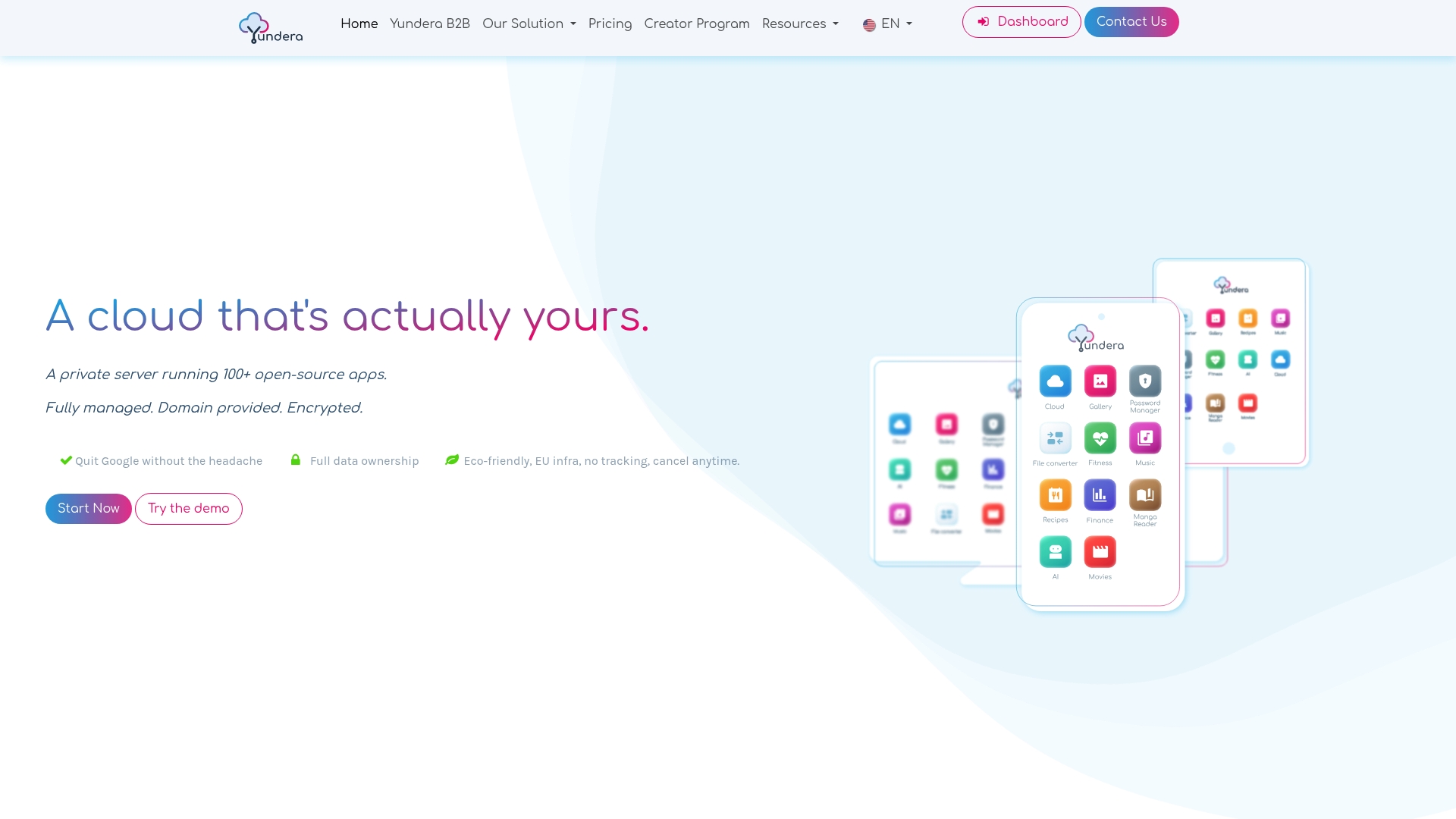
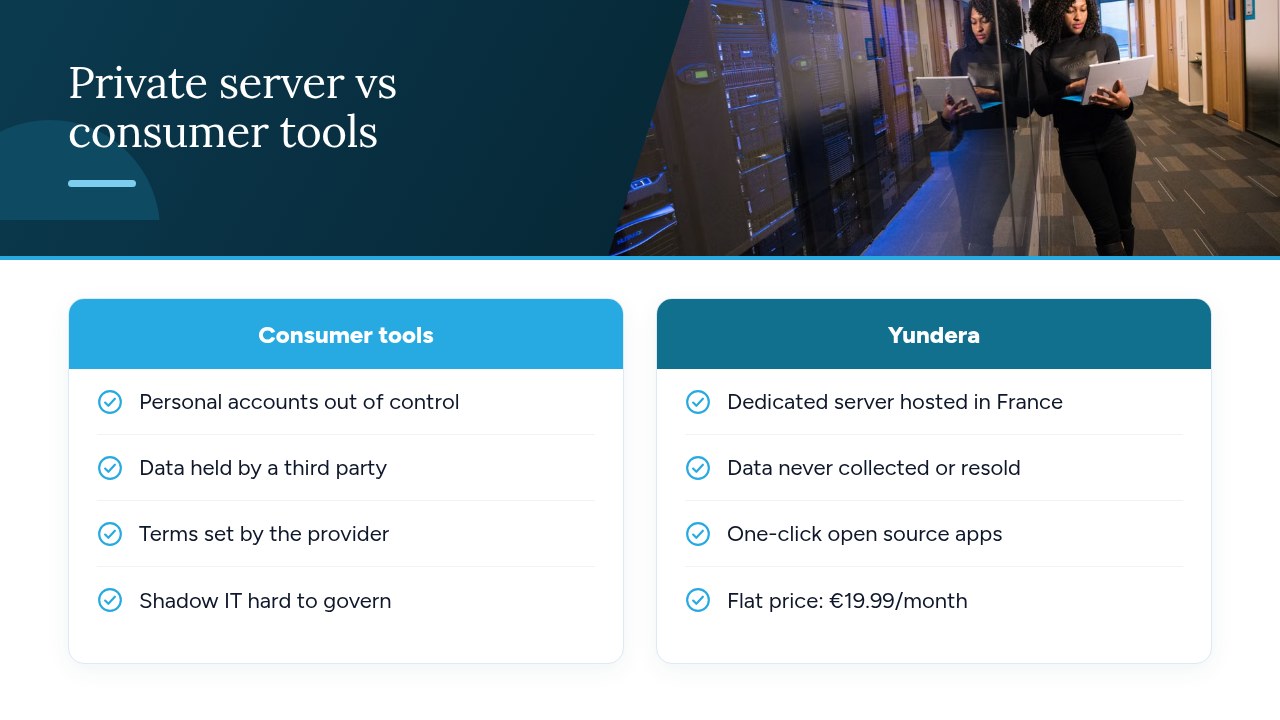
For an allowlist to be respected, every need must have an approved tool that the company controls. Yundera is a practical option for this: a managed private server (Personal Cloud Server), hosted in France and dedicated to a single customer. From an app store, you install ready-to-use open source applications in one click, including for file storage, photos, website hosting and office work. In the charter, the clause becomes concrete: “company files are stored and shared only on files.your-domain.com”, rather than just “personal Dropbox forbidden”.
Three things make the clauses easier to write:
- An address in your name: every application is reachable over HTTPS on your own domain, with no static IP, no port forwarding and no certificates to configure by hand.
- Data that stays with you: it stays on your server, and Yundera neither collects nor sells it. The “no data in third-party accounts” clause becomes consistent with your own tools.
- No technical team needed: Yundera manages the server, and the standard plan costs a flat €19.99 per month (pricing).
Your charter's access rules apply to these tools too: named accounts, closed on the day someone leaves, passwords in line with our guide on password policy. To see how to designate such a server as your team's official tool, visit the Yundera private servers page.
IT charter: the most common mistakes
The most common mistakes are procedural, not about wording. Companies copy a generic template that mentions tools they don't have and ignores the ones they actually use. They skip the CSE consultation, which makes the charter unenforceable. They switch on logs without describing them, even though Article L1222-4 makes such evidence unusable. They ban Dropbox or WeTransfer without offering an alternative, and shadow IT comes back. They forget interns and contractors. They never update the text. And some companies still file the text with the tribunal clerk, a formality abolished by the Law of 26 May 2026, while neglecting publication and submission to the labour inspectorate.
Pre-publication checklist: 1. every rule maps to a real tool and a means of checking it; 2. every form of monitoring is described with its purpose and retention period; 3. a list of approved tools covers every need; 4. the CSE has given its opinion; 5. the charter has been published and sent to the labour inspectorate, then applied at least one month later; 6. acknowledgements of receipt are signed, contractors included; 7. an annual review date is in your calendar.
Sources
- French Labour Code, Articles L1321-1 to L1321-6 (content and validity conditions of internal work rules) - Légifrance
- Article L1222-4 - French Labour Code - Légifrance
- Company internal work rules - Entreprendre.Service-Public.fr
- Internal work rules: end of the clerk filing requirement in 2026 - Éditions Tissot
- 10 essential measures for your cybersecurity - Cybermalveillance.gouv.fr
Frequently Asked Questions
Is an IT charter mandatory in a company with fewer than 50 employees?
No. Under French law, no text requires a charter, and internal work rules are only mandatory from 50 employees. However, if the charter imposes general and permanent obligations, Article L1321-5 of the Labour Code subjects it to the same regime as the work rules: CSE opinion where a CSE exists, publication and submission to the labour inspectorate.
Should every employee sign the IT charter?
A signature does not make the charter enforceable: the work-rules procedure does. It is still useful to prove the employee actually received the document. It is essential for contractors and temporary workers, who are not subject to the internal work rules.
Can an employee be disciplined for breaching the IT charter?
Yes, if the charter was adopted under the work-rules procedure (CSE opinion, publication, submission to the labour inspectorate) and the sanction appears in the defined scale. A charter that was simply emailed out is only a recommendation and cannot support a sanction.
Can an employer read employees' emails?
Messages in a work mailbox may be accessed if employees were informed in advance of possible monitoring, as required by Article L1222-4 of the French Labour Code. Messages clearly marked as personal cannot be opened like other messages, and constant monitoring is disproportionate. Before drafting the clause, consult the CNIL's guidance on workplace monitoring.
Does the IT charter still have to be filed with the employment tribunal in 2026?
No. Law No. 2026-403 of 26 May 2026 abolished filing the internal work rules, and therefore their annexes, with the clerk of the employment tribunal (conseil de prud'hommes). The CSE opinion, publication, submission to the labour inspectorate and the one-month delay before entry into force remain mandatory.
Company IT Charter: What to Include and How to Roll It Out