A Managed, Sovereign Ollama Server Hosted in France

Yes, you can get a fully managed Ollama server, hosted in France, with contractual guarantees on data sovereignty. For freelancers and SMEs that want to put a large language model (LLM) to work without touching a single line of configuration, this option exists — and it meets GDPR requirements. Here is what it means in practice:
- Data residency in France: your data stays on French servers, beyond the reach of the US Cloud Act.
- Guaranteed GDPR compliance: the provider acts as a processor within the meaning of Article 28 of the GDPR.
- Guaranteed data export: you can retrieve your data at any time, in standard formats.
- SLA and support included: uptime, updates and security are handled by the provider, not by you.
Key takeaways
A managed Ollama server hosted in France lets SMEs and freelancers run a sovereign LLM without technical skills, backed by contractual guarantees on GDPR compliance and data export.
| Point | Details |
|---|---|
| Feasibility in France | A managed, sovereign, GDPR-compliant LLM server is available to French SMEs and freelancers. |
| Key benefits | Predictable costs, data resident in France, integration with internal tools without DevOps skills. |
| Contractual guarantees | Insist on data export in standard formats, a documented SLA and a deletion clause at end of contract. |
| Time to production | A pilot is up and running in 4 to 6 weeks, from initial assessment to production. |
| Recommended solution | Yundera offers a managed private server, hosted in France, with guaranteed export and support included. |
Table of contents
- What exactly is a managed Ollama server?
- Why a managed LLM server is a game changer for an SME
- Concrete use cases for your business
- Getting started without technical skills: the key steps
- Compliance, GDPR and the AI Act: what you need to check
- What budget should you plan for a managed LLM server?
- Support and SLA: what a good provider must guarantee
- Export and portability: what to demand before signing
- What SMEs often underestimate in this decision
- Yundera: a managed private server, hosted in France, ready to use
- Sources
What exactly is a managed Ollama server?
The term “ollama server” here refers to an instance of the Ollama inference engine, deployed on a private server hosted in France and administered end to end by a provider. You install nothing and configure nothing. The provider takes care of deployment, updates and operational security.
This is a radically different approach from technical self-hosting (DIY), which demands skills in system administration, networking and model management. With a managed server, you get a ready-to-use open source local AI, with no technical friction.
A managed service typically includes:
- The Ollama instance with the LLM model or models of your choice (Mistral, LLaMA, Gemma, etc.)
- The server (GPU or CPU depending on your needs), the user interface and the API connectors
- Automatic backups, monitoring and on-demand data export
Sovereign AI specifically means solutions whose design, hosting and operation fall under French or European jurisdiction, ensuring that European law applies.
Why a managed LLM server is a game changer for an SME
The benefits are concrete and measurable, not just theoretical.
- Data sovereignty: your documents, contracts and conversations never pass through American or Asian servers. Digital sovereignty is becoming a priority for small businesses and SMEs that want to reduce their dependence on foreign vendors.
- Budget predictability: a fixed monthly subscription replaces the token-based pricing of public clouds, where the bill can triple in a matter of weeks depending on usage. Moving to a sovereign AI infrastructure helps SMEs escape the pricing trap set by international providers.
- Integration with internal tools: the LLM server can connect to your documents (RAG), your CRM or your ERP without exposing that data to the outside world. According to Alexis Facques, what SMEs mostly need are sovereign agents able to retrieve documents and cross-reference internal data, not a general-purpose AI.
- Immediate productivity gains: document search, email drafting, meeting summaries, invoicing assistance — recurring tasks that eat up several hours a week.
The hidden costs of an AI project include model maintenance, audit log storage and business integration. Managed solutions often cut these line items compared with DIY.
Concrete use cases for your business
Here are realistic scenarios, suited to organisations with no dedicated technical team.
- Freelance consultant: automatic indexing of contracts and proposals, so a clause can be found in seconds rather than twenty minutes.
- Service SME: generating first drafts of client emails from internal notes, with an estimated saving of 30–45 minutes a day for a team of five.
- Accounting or law firm: summarising long documents (reports, legal deeds) to prepare for a client meeting without re-reading the entire file.
- Sales team: an internal assistant that answers product questions using in-house documentation, without exposing that documentation to a third-party service.
- Tradesperson or micro-business: help writing quotes, follow-ups and replies to customer reviews, straight from the server’s interface.
None of these use cases requires AI expertise. What they require is a well-configured server and well-organised data.
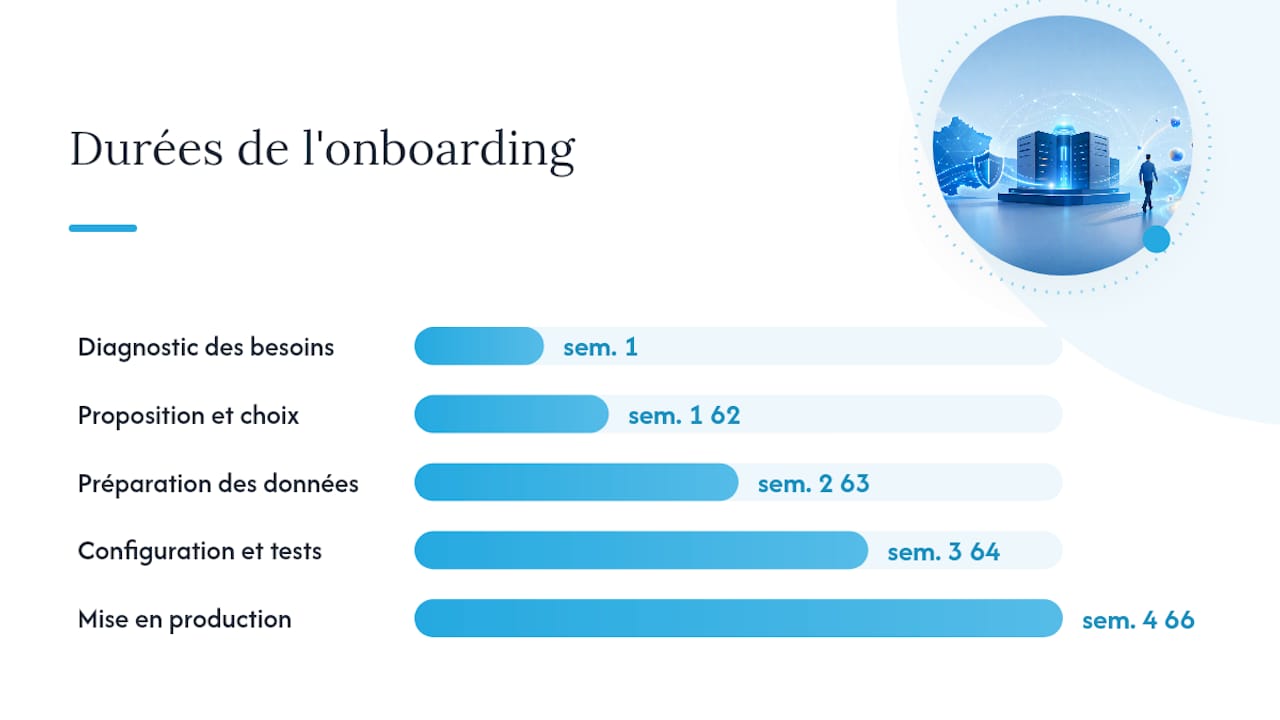
Getting started without technical skills: the key steps
Onboarding a managed Ollama server follows a clear sequence, from first contact to production.
- Needs assessment (week 1): the provider identifies your priority use cases, the volume of data to process and your compliance constraints. You provide an overview of your current tools.
- Proposal and model selection (weeks 1–2): choosing the right LLM (size, language, specialisation), defining the SLA and signing the contract including the GDPR clauses (Art. 28).
- Data preparation (weeks 2–3): you gather an initial set of representative documents. The provider configures RAG indexing on that basis.
- Server configuration and pilot testing (weeks 3–4): deploying the instance, functional testing with your real data, model fine-tuning.
- Go live (weeks 4–6): opening access to your teams, training on the interface, activating monitoring and automatic backups.
The success of a sovereign AI project depends as much on data governance as on the technology itself. The French government is also pushing towards operational solutions rather than fundamental research alone.
Pro tip: For an effective RAG pilot, build a corpus of 50 to 200 consistent documents (same format, same domain) rather than a mixed bag of thousands of files. Corpus quality matters more than quantity.
Compliance, GDPR and the AI Act: what you need to check
French and European regulations set out precise requirements as soon as you process personal or business data with an LLM.
- GDPR and Article 28: your provider must sign a data processing agreement specifying the purposes of processing, the security measures and the right to erasure.
- Data residency: require contractually that data never leaves French or European territory, including backups and audit logs.
- AI Act: since 2025, certain AI use cases are subject to transparency and documentation obligations. Check how your use case is classified (limited or high risk) with your provider.
- Technical security: encryption of data at rest and in transit (TLS 1.3, AES-256), accessible audit logs, multi-factor authentication (MFA) and a log retention policy.
- SecNumCloud: for sensitive use cases (healthcare, financial data, defence), favour hosting on SecNumCloud-qualified infrastructure. Forensic audit measures are recommended in these contexts.
The France 2030 initiatives actively encourage the emergence of AI solutions hosted in France, making it easier for SMEs to access suitable — and sometimes subsidised — offerings.
What budget should you plan for a managed LLM server?
Pricing for a managed Ollama server depends on several variables. Here are the main factors:
- Compute capacity: a CPU server is enough for lightweight models (7B parameters); a GPU is needed for more powerful models (13B and above) or high request volumes.
- Storage and log retention: the disk space for your indexed documents and how long audit logs are kept have a direct impact on the monthly cost.
- SLA level: guaranteed 99.9% uptime costs more than a 99.5% SLA, with different response time commitments.
- Support included: support by email, chat or phone, with or without on-call coverage.
For a pilot profile (lightweight model, team of 1 to 5 people, limited storage), managed offerings generally start at a few tens of euros per month. A production profile with GPU, an enhanced SLA and significant data volumes sits in a higher bracket. Always ask for a modular offer so you can scale up gradually, without committing to oversized capacity from day one.
Support and SLA: what a good provider must guarantee
A serious managed Ollama server comes with clear operational commitments, not vague promises.
- Uptime: an SLA of at least 99.5% is expected for professional use, with scheduled maintenance windows announced in advance.
- Updates: the provider handles security updates for the server and the model, with no action needed on your side.
- Monitoring: 24/7 monitoring, automatic alerts when anomalies occur, regular backup restoration tests.
- Reporting: accessible audit logs, incident reports and usage dashboards delivered on a regular basis.
Insist on a documented disaster recovery plan, a tested data export procedure and proof of permanent deletion at the end of the contract. These three elements are what separate a serious provider from an opportunistic offer.
Export and portability: what to demand before signing
Data portability is a non-negotiable guarantee. Here is what the contract must cover:
- Full data export in standard formats (JSON, CSV, open formats) with no hidden fees.
- Access to backups, encryption keys and API documentation to make migrating to another provider straightforward.
- An end-of-contract clause specifying the data retrieval window (ideally 30 days) and permanent, certified deletion on the provider’s infrastructure.
The practical handover procedure generally follows this order:
- Termination notice and confirmation of the contractual deadline.
- Generation and delivery of the full archive (data, fine-tuned models, configurations).
- Handover of encryption keys and API documentation.
- Written confirmation of permanent deletion on the provider’s servers.
What SMEs often underestimate in this decision
Most decision-makers focus on the LLM model and overlook what really matters: the quality of the managed service around it. A high-performing model on poorly maintained infrastructure, with no clear SLA or export procedure, exposes the business to operational and regulatory risks far more costly than the price of the subscription.
The managed, sovereign approach is not a luxury for small organisations. It is often the only realistic way to deploy an LLM without hiring a full-time DevOps engineer. Cost control, GDPR compliance and service continuity are arguments that weigh heavily against the apparent freedom of DIY.
Before any broad rollout, a four- to six-week pilot on a specific use case remains the best way to validate the real value of the service for your business.
Yundera: a managed private server, hosted in France, ready to use
Your private LLM, with no server to administer and no data exposed to third parties: that is exactly what Yundera offers.
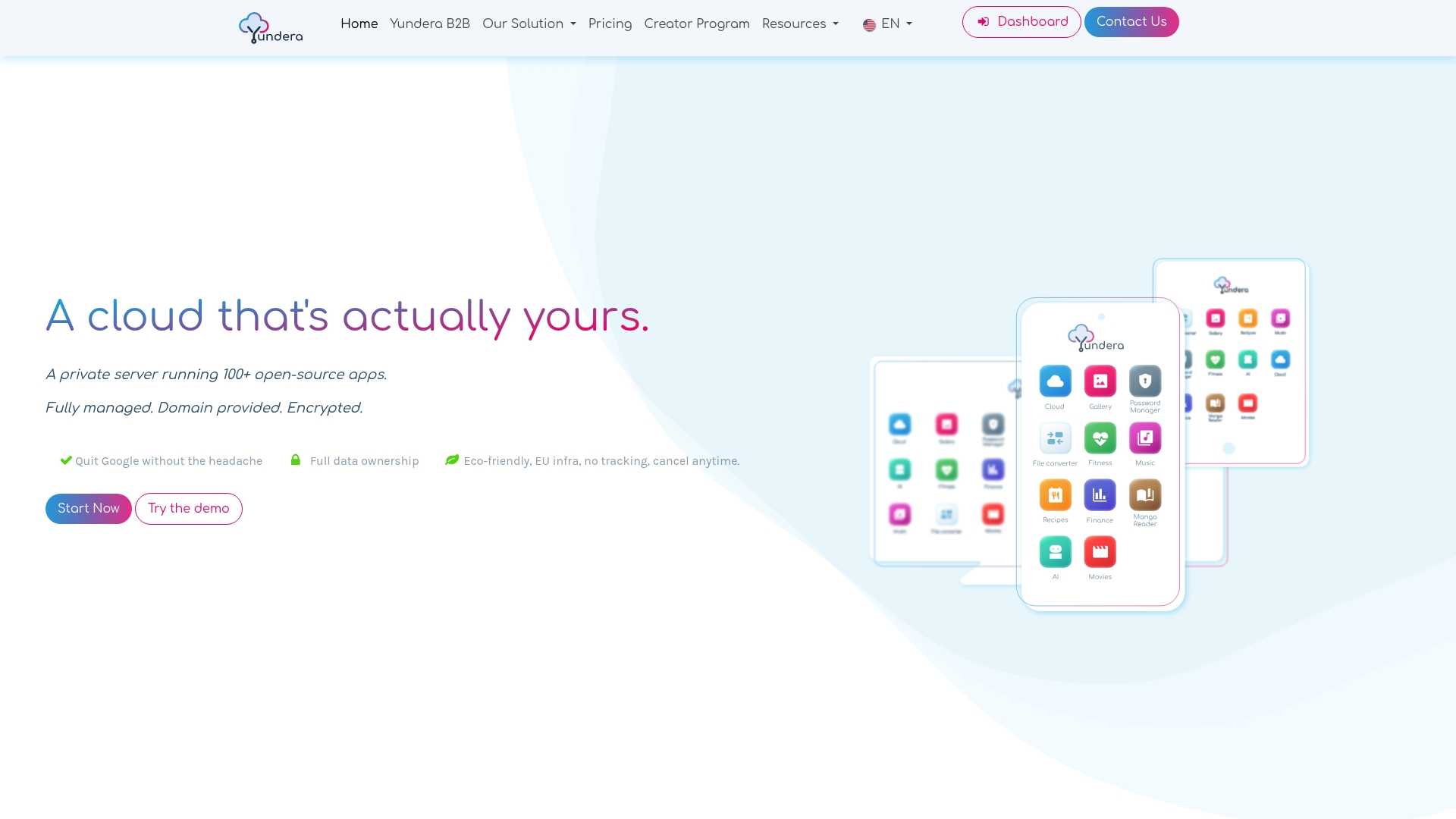
Yundera deploys your private cloud server with a preconfigured Ollama instance, hosted in France on 100% ethical infrastructure. No data is collected or resold. Exporting your data is guaranteed at any time, in standard formats. Support, updates and security are handled by Yundera, not by you.
For startups and SMEs that want to keep IT costs under control without sacrificing sovereignty, Yundera offers a modular package: choose your capacity, your models and your SLA level. Deployment follows a structured process, from the initial assessment to going live, in a matter of weeks.

Contact Yundera to start your assessment and receive a proposal tailored to your use case.
Sources
- Integrating AI into internal tools: the sovereignty challenge for small businesses and SMEs
- Sovereign AI for SMEs and mid-caps: France 2030 opportunities
- Sovereign AI: definition, challenges and key players
- Local AI and MCP: the sovereign solution that boosts ROI for French SMEs
A Managed, Sovereign Ollama Server Hosted in France